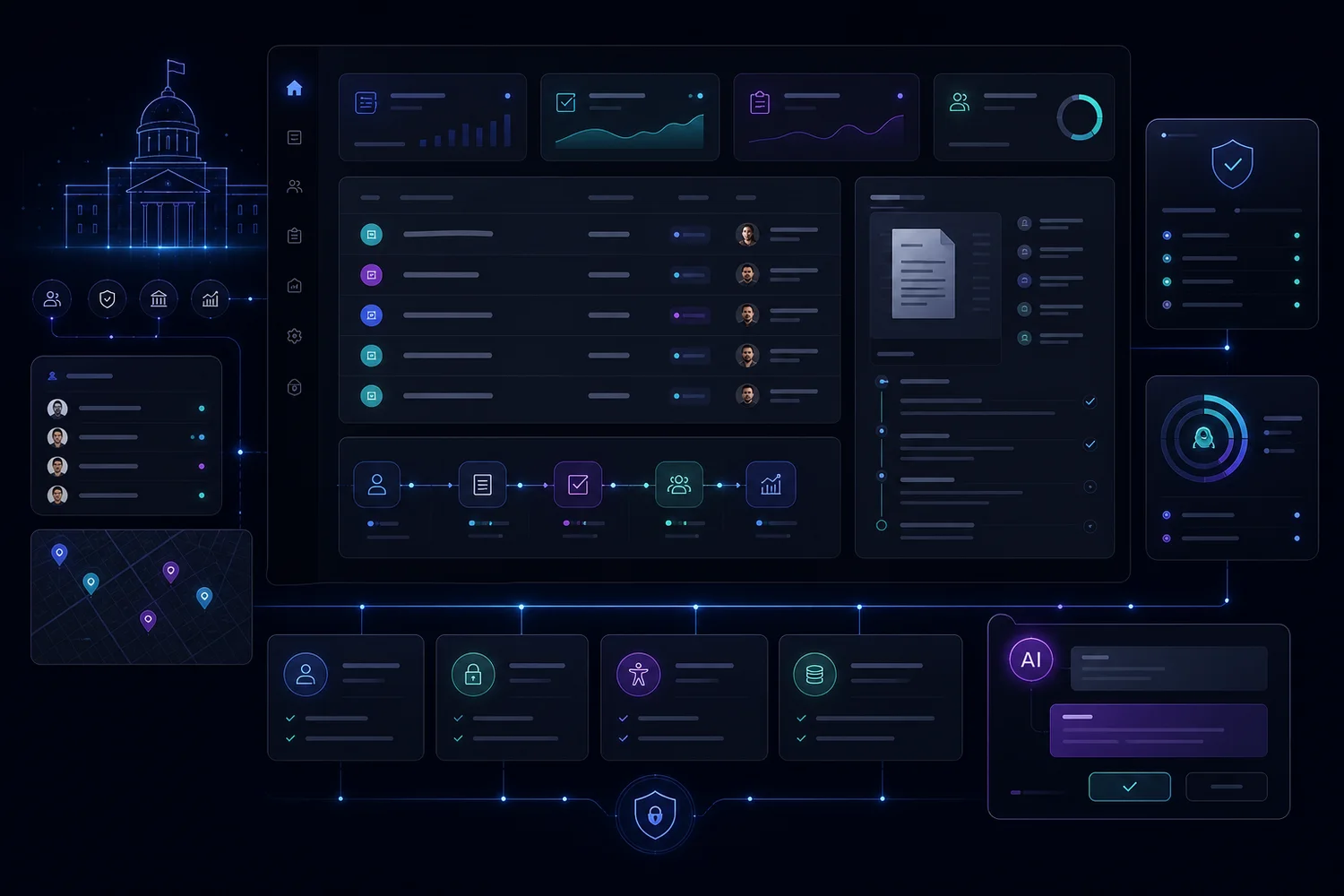
Workflow architecture
Intake, triage, assignment, escalation, status, and documentation flows are defined before software delivery.
Auvant helps municipalities, government organizations, and institutions modernize operations with bilingual, accessible, documented systems built for long-term ownership.
Auvant Technologies is a Quebec-based software, AI, and automation company. We design web tools, internal systems, and digital workflows for organizations that need to balance public service, security, accessibility, governance, and long-term maintainability.
Services in French and English
Documentation, handoff, and clear system ownership
Accessibility-oriented design targeting WCAG 2.1 AA
Careful approach to data, access, and deployment
A public-sector mandate should produce more than a demo. We prepare prototypes, process maps, data matrices, and operational views so teams can judge scope, risk, and value.
Auvant does not start by drawing isolated screens. We map the real work: requests, approvals, data, teams, contractors, exceptions, and resident communications. AI agents are then used to automate repeatable tasks, with guardrails and human oversight.
Intake, triage, assignment, escalation, status, and documentation flows are defined before software delivery.
Agents can assist triage, search, drafting, reminders, and routing without taking sensitive decisions away from people.
Roles, approvals, logs, exceptions, and review points remain visible to municipal or administrative teams.
Deliverables include process maps, rules, acceptance criteria, and documentation so the system remains maintainable.
A public digital project is not won by a polished interface alone. It has to reassure leadership, reduce field-team work, respect IT constraints, and remain understandable after delivery. That combination is what we build around.
Clarity on scope, risks, likely costs, decision steps, and expected outcomes.
Fewer calls, less duplicate entry, visible statuses, dashboards, and workflows that reflect real work.
Readable architecture, controlled access, protected secrets, documentation, handoff, and suitable hosting options.
Bilingual, accessible, mobile-friendly services that are clear enough to use without calling for every question.
The work is structured to reduce procurement risk: clear scope, verifiable milestones, useful documentation, and traceable decisions.
Objectives, constraints, users, data, risks, and bilingual/accessibility requirements.
Deliverable scope, priorities, architecture, acceptance criteria, and deployment plan.
Regular releases, demos, testing, corrections, and continuous documentation.
Controlled deployment, handoff, light training, and post-delivery support.
We make the work concrete for public teams: understandable requirements, documented decisions, visible risks, and deliverables that are easy to review.
Content, forms, and workflows are designed to work in French and English without one language feeling secondary.
Each phase can produce evidence: prototype, acceptance criteria, demo, decision log, or documentation.
We prefer choices that are simple to operate, documented, and suited to the organization's internal capacity.
The mandate should leave a system that can be understood: versioned code, clear configuration, documentation, and recovery notes.
This matrix is not legal advice or a certification. It explains how we structure work to support the obligations of a public organization.
SGQRI / WCAG-oriented design, contrast, keyboard use, labels, semantic structure, and form validation.
Checklist, keyboard tests, interface correctionsData minimization, justified collection, retention discussed, limited access, and validation of required fields.
Data inventory, decision notes, access configurationEncrypted transport, separated environments, secrets outside code, least-privilege access, and logging according to risk.
Deployment diagram, access log, recovery procedureIndexable French/English routes and content, consistent labels, bilingual emails, and bilingual form states.
Content inventory, FR/EN pages, consistency reviewHuman oversight, clear limits, useful traceability, escalation, and no fully automated sensitive decisions without proper scoping.
Usage policy, decision register, exception scenariosSupport documentation, handoff, acceptance criteria, configuration backup, and maintenance plan.
Operations guide, change log, acceptance criteriaCitizen request intake and internal follow-up automation
Bilingual portals for forms, registrations, or service requests
Document processing, data extraction, and case routing
Dashboards for operations, compliance, or accountability reporting
Case, permit, inspection, or approval workflow tools
Migration, cleanup, and consolidation of operational data
We frame projects as complete operational systems: residents, staff, data, statuses, exceptions, reporting, and handoff. The goal is to show what changes in a normal workday.
Residents need to know what to put out, when to put it out, what to do after a missed pickup, and where special materials go.
Bilingual app with address-based calendar, reminders, reporting, AI sorting guide, ecocentre content, and a staff tracking dashboard.
Route calendar, knowledge base, reporting flow, admin dashboard, exports, and management documentation.
Requests arrive by email, phone, generic forms, or social messages, then get lost between departments.
One portal with photos, categories, location, status, assignment, internal notes, notifications, and accountability reporting.
Public form, internal queue, access roles, statuses, bilingual notifications, history, and tracking filters.
Incomplete files, rescheduled inspections, and email follow-up create delays that are hard to explain.
Permit workflow with required documents, comments, applicant status, inspection scheduling, approval, and decision history.
Requirement list, applicant portal, staff view, decision log, inspection calendar, and acceptance criteria.
Teams read, classify, summarize, and re-key repetitive documents even when several steps can be assisted.
Console that extracts fields, proposes classification, summarizes content, routes the case, and keeps human validation visible.
Data model, validation rules, review screen, correction log, exports, and AI usage limits.
Contracted work needs proof, statuses, exceptions, photos, and fast communication with internal teams.
Coordination dashboard with work orders, confirmations, route exceptions, photos, comments, and service-level tracking.
Vendor workspace, operations dashboard, exception management, notifications, attachments, and performance report.
The best public-sector projects are not abstract. They replace visible friction with clearer paths for residents and staff.
PDF calendars, repetitive calls, uncertain sorting, and missed-pickup reports that are hard to track.
Bilingual app with reminders, AI sorting guide, ecocentre guidance, reporting, and staff dashboard.
Scattered emails, lost photos, manual statuses, and limited cross-service visibility.
Resident portal, assigned cases, statuses, notifications, and accountability exports.
Incomplete files, email follow-ups, inspection rescheduling, and opaque queues.
Traceable workflow with files, comments, inspections, approvals, and applicant status.
Manual reading, inconsistent filing, duplicate entry, and processing delays.
Assisted extraction, human validation, classification, routing, and searchable history.
Phone confirmations, route blind spots, late exceptions, and hard-to-collect proof.
Vendor dashboard with work orders, photos, exceptions, updates, and operational tracking.
Teams searching for AI automation Montreal, software design Montreal, public sector software development, or municipal software automation usually share the same need: replacing fragile manual follow-up with reliable, bilingual, governable tools.
Triage, extraction, classification, staff assistance, and automation governed by human validation.
Web applications, citizen portals, internal tools, and accessible interfaces for public services.
Digital workflows for requests, permits, inspections, approvals, and accountability reporting.
Auvant can participate without forcing a large project immediately. A mandate can start small, produce concrete deliverables, then expand into implementation.
Scoping noteMap the process, data, users, risks, and implementation estimate.
Functional prototypeTest a real workflow with screens, logic, simulated data, and decision criteria.
Implementation mandateBuild, integrate, document, and launch the system with follow-up.
Vendor collaborationWork with an IT team, integrator, municipal vendor, or existing internal service.
We make decisions visible. Even an exploratory mandate should produce artifacts that leadership, operations, IT, and procurement can review without depending on a live demo.
Steps, roles, pain points, systems used, data handled, and recurring exceptions.
Key screens, resident path, staff path, error states, and status logic.
Collected fields, justification, visibility, roles, retention to discuss, and known risks.
Concrete conditions for saying a feature is ready, testable, and operable.
Phases, dependencies, migration, training, launch, support, and next decisions.
Configuration, accounts, environments, basic procedures, and things to watch after launch.
Which operational problem costs the most time today?
What personal information is actually necessary?
Which users need to view, edit, or approve each step?
Which decisions must remain human even if AI assists the work?
What proof, logging, or reporting will be useful for accountability?
What first deliverable lets the team decide without committing the whole budget at once?
Turn manual processes into reliable, measurable, maintainable digital workflows.
Assistants, extraction, triage, and decision automation with guardrails and human oversight.
Tools for citizen services, internal operations, permits, requests, and reporting.
Reduce duplicate entry, connect existing systems, and improve team visibility.
French/English interfaces, semantic web, keyboard access, contrast, and accessible forms.
We do not claim certifications we do not hold. Our posture is practical: data minimization, access control, encrypted transport, separated environments, logging where needed, version-controlled code, documentation, and hosting choices suited to the mandate.
Public-facing projects should be usable by more people, not merely faster to ship. We target WCAG 2.1 AA, test keyboard navigation, pay attention to contrast, and build French and English interfaces from the start.
Limited accessRoles, permissions, and technical accounts defined around actual need.
Separated environmentsDevelopment, testing, and production separated when the mandate requires it.
Protected secretsAPI keys and sensitive settings kept outside source code.
TraceabilityLogs, change history, and documented decisions according to risk level.
AI should help staff and residents, not create a black box. For public services, we design assistants and automations with human validation, response boundaries, and escalation paths.
Assisted responseAI can suggest, summarize, or route, while sensitive decisions remain controlled.
Sources and limitsImportant answers can be tied back to approved rules, documents, or content.
Clear escalationWhen AI is uncertain, the flow should move to a human or official resource.
These examples show concrete mandate formats we can scope, prototype, and deliver.
A bilingual form, internal tracking board, notifications, and accountability exports.
Field extraction, human validation, case classification, and synchronization with existing tools.
Indicators, filters, access roles, and consolidated data to reduce spreadsheet dependency.
A short format to produce something useful before committing to a full implementation.
Workshops, current process, users, data, risks, and procurement constraints.
Prototype of key screens, target architecture, and bilingual scenarios.
Stakeholder validation, adjustments, estimate, and roadmap.
Decision package: scope, indicative budget, risks, deliverables, and implementation plan.
Yes. Auvant designs AI automation and software automation systems for organizations in Montreal and Quebec, with particular attention to bilingual delivery, accessibility, and documentation.
Yes. We structure mandates for public-sector contexts: clear scope, verifiable milestones, documentation, knowledge transfer, and traceable decisions.
Strong candidates include citizen requests, permits, inspections, internal follow-up, document processing, operational reports, and dashboards.
We target WCAG 2.1 AA, design in French and English, minimize collected data, control access, and adapt hosting choices to the mandate requirements.
A short discussion is often enough to identify the right format: scoping note, proof of concept, fixed mandate, or ongoing support.